ASCL1 抗体 (C-Term)
 (1 validation)
Our Local Distributor
北京 101111
Quick Overview for ASCL1 抗体 (C-Term) (ABIN6260073)
抗原
See all ASCL1 抗体适用
宿主
克隆类型
标记
应用范围
-
-
抗原表位
- C-Term
-
原理
- ASCL1 Antibody
-
特异性
- ASCL1 Antibody detects endogenous levels of total ASCL1.
-
预测反应
- Pig,Bovine,Sheep,Rabbit,Dog,Chicken,Xenopus
-
纯化方法
- The antiserum was purified by peptide affinity chromatography using SulfoLink™ Coupling Resin (Thermo Fisher Scientific).
-
免疫原
- A synthesized peptide derived from human ASCL1, corresponding to a region within C-terminal amino acids.
-
亚型
- IgG
-
-
anti-Achaete-Scute Complex Homolog 1 (Drosophila) (ASCL1) (AA 186-236) antibody
ASCL1 适用: 人, 小鼠 WB, IHC, ICC, FACS, IP 宿主: 兔 Monoclonal BLR164J unconjugated Recombinant Antibody
anti-Achaete-Scute Complex Homolog 1 (Drosophila) (ASCL1) (AA 151-236) antibodyASCL1 适用: 人 WB, IHC (p), IF (cc), IF (p), IHC (fro) 宿主: 兔 Polyclonal unconjugated
anti-Achaete-Scute Complex Homolog 1 (Drosophila) (ASCL1) antibodyASCL1 适用: 人 ELISA, IHC 宿主: 兔 Polyclonal unconjugated
anti-Achaete-Scute Complex Homolog 1 (Drosophila) (ASCL1) (AA 137-236) antibodyASCL1 适用: 人 WB, ELISA 宿主: 小鼠 Monoclonal 3D3 unconjugated
anti-Achaete-Scute Complex Homolog 1 (Drosophila) (ASCL1) (N-Term) antibodyASCL1 适用: 人, 小鼠, 大鼠, Cow, 豚鼠, 犬, 兔 WB, IHC 宿主: 兔 Polyclonal unconjugated
anti-Achaete-Scute Complex Homolog 1 (Drosophila) (ASCL1) (AA 63-90), (N-Term) antibodyASCL1 适用: 人 WB 宿主: 兔 Polyclonal RB41522 unconjugated
anti-Achaete-Scute Complex Homolog 1 (Drosophila) (ASCL1) (AA 48-97) antibodyASCL1 适用: 人, Cow, 豚鼠, 猴 WB, IHC, IHC (p) 宿主: 兔 Polyclonal unconjugated
anti-Achaete-Scute Complex Homolog 1 (Drosophila) (ASCL1) (AA 1-236) antibodyASCL1 适用: 人 WB, ELISA, IHC 宿主: 兔 Polyclonal unconjugated
anti-Achaete-Scute Complex Homolog 1 (Drosophila) (ASCL1) (AA 2919-2969) antibodyASCL1 适用: 人, 小鼠 WB, IP, IHC (fp) 宿主: 兔 Polyclonal unconjugated
anti-Achaete-Scute Complex Homolog 1 (Drosophila) (ASCL1) (AA 84-236) antibodyASCL1 适用: 人 WB, IHC, ICC, IP 宿主: 兔 Polyclonal unconjugated
-
-
应用备注
- WB 1:1000-3000, IHC 1:50-1:200 IF/ICC 1:100-1:500
-
限制
- 仅限研究用
-
-
- by
- Cantù Lab, Gene Regulation during Development and Disease, Linköping University
- No.
- #104600
- 日期
- 2026.03.01
- 抗原
- ASCL1
- Lot Number
- 35Y1322
- Method validated
- Cleavage Under Targets and Release Using Nuclease
- Positive Control
Anti H3K4me3 (ABIN6971977)
- Negative Control
Guinea Pig anti-Rabbit IgG (Heavy & Light Chain) Antibody - Preadsorbed (ABIN101961)
- Notes
Passed. ABIN6260073 allows for ASCL1 targeted digestion using CUT&RUN in human neuroendocrine cancer cells.
- Primary Antibody
- ABIN6260073
- Secondary Antibody
- Full Protocol
- Organoid dissociation into single cells and nuclear extraction. Harvest 200,000 neuroendocrine cancer (NEC) cells per sample. Collect cells in PBS with 0.1% BSA.
- Centrifuge cell solution for 5 min at 400 × g at RT. Remove the liquid carefully.
- Gently resuspend cells in 1 mL of Nuclear Extraction Buffer (20 mM HEPES-KOH pH 8.2, 20% glycerol, 0.05% IGEPAL, 0.5 mM spermidine, 10 mM KCl, 1× PMSF).
- Pellet the nuclei at 800 × g for 5 min. Repeat the NE washes for a total of three washes.
- Resuspend the nuclei in 20 µL NE Buffer per sample.
- Concanavalin A beads preparation
- Prepare 20 µL magnetic Concanavalin A Beads (antibodies-online, ABIN6923139) by 3 washes with 1 mL Binding Buffer (20 mM HEPES pH 7.5, 10 mM KCl, 1 mM CaCl2, 1 mM MnCl2). Gently resuspend the ConA Beads in a volume of Binding Buffer corresponding to the original volume of bead slurry, i.e. 20 µL per sample.
- Nuclei immobilization – binding to Concanavalin A beads
- Carefully resuspend the nuclei suspension and add 20 µL of the Con A beads in Binding Buffer to the cell suspension for each sample. Let nuclei bind to beads for 15 min at 4 °C with rotation.
- Remove the supernatant and resuspend the beads in 200 µL Wash Buffer per sample and divide the cell suspension into separate 200 µL PCR tubes, one for each sample (replicate or antibody).
- Remove the supernatant and resuspend the beads in 200 µL of EDTA wash buffer (20 mM HEPES pH 7.5, 150 mM NaCl, 0.5 mM spermidine, 1× PMSF, 2 mM EDTA).
- Incubate 5 min at RT.
- Primary antibody binding
- Prepare 200 µL antibody solution (Wash Buffer with 0.025% digitonin, 2 mM EDTA, and 0.1% BSA) per sample.
- Add 2 µL antibody to the respective tube, corresponding to a 1:100 dilution.
- Incubate at 4 °C overnight.
- Wash with 200 µL of Wash Buffer containing 0.025% digitonin for a total of five washes.
- pAG-MNase binding
- Prepare 200 µL/sample Wash Buffer containing 0.025% digitonin and 120 ng pAG-MNase/sample. Resuspend beads in pAG-MNase premix.
- Incubate 45 min at 4 °C.
- Wash with 200 µL of Wash Buffer containing 0.025% digitonin for a total of five washes.
- MNase digestion and release of pAG-MNase-antibody-chromatin complexes
- Place PCR tubes on ice and allow to chill.
- Resuspend in 50 µL of prechilled 2 mM CaCl2 in Wash Buffer mix and incubate on ice for exactly 30 min.
- Add 3 µL EDTA (250 mM)-EGTA (250 mM) STOP-Mix per sample, and transfer prerelease into new tubes.
- Resuspend the remaining beads in 50 µL of 1× Urea Buffer (8.5 M urea, 100 mM NaCl, 2 mM EGTA, 2 mM EDTA, 0.5% IGEPAL).
- Incubate the samples for 45 min at RT.
- Remove the urea release from the beads and combine it with the prerelease.
- Inactivate the release by adding 96 µL 10 mM Tris, 2 µL SDS 10%, and 2 µL Proteinase K per sample, then incubate at 50 °C for 1 h.
- DNA clean-up and sequencing
- Clean up DNA by standard phenol-chloroform extraction with overnight precipitation.
- Prepare libraries using KAPA HyperPrep Kit with KAPA Dual-Indexed adapters according to protocol.
- Sequence samples on an Illumina NextSeq 500 sequencer, using a NextSeq 500/550 High Output Kit v2.5 (75 cycles), 36 bp PE.
- Alignment
- Trim reads using bbTools bbduk (BBMap - Bushnell B. - sourceforge.net/projects/bbmap/) to remove adapters, artifacts, and repeat sequences.
- Aligned reads were mapped to the hg38 human genome using bowtie with options
-m 1 -v 0 -I 0 -X 500. - Use SAMtools to convert SAM files to BAM files and remove duplicates.
- Use BEDtools genomecov to produce BedGraph files.
- Organoid dissociation into single cells and nuclear extraction. Harvest 200,000 neuroendocrine cancer (NEC) cells per sample. Collect cells in PBS with 0.1% BSA.
- Experimental Notes
生效 #104600 (Cleavage Under Targets and Release Using Nuclease)
 Validation Images
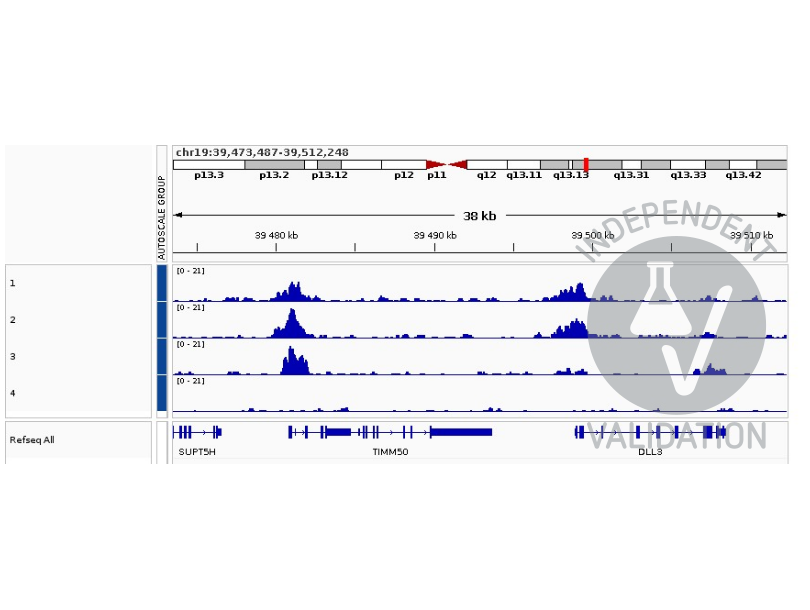
![1+2. Two replicated alignment tracks from CUT&RUN targeting ASCL1 in neuroendocrine cancer organoids using anti-ASCL1 antibody ABIN6260073.
3. Positive Control: Alignment tracks from CUT&RUN targeting H3K3me3 in neuroendocrine cancer organoids using anti-H3K4me3 antibody ABIN6971977.
4. Negative Control: Alignment tracks from CUT&RUN targeting and unspecific IgG.]() 1+2. Two replicated alignment tracks from CUT&RUN targeting ASCL1 in neuroendocrine cancer organoids using anti-ASCL1 antibody ABIN6260073.
3. Positive Control: Alignment tracks from CUT&RUN targeting H3K3me3 in neuroendocrine cancer organoids using anti-H3K4me3 antibody ABIN6971977.
4. Negative Control: Alignment tracks from CUT&RUN targeting and unspecific IgG.
Full Methods
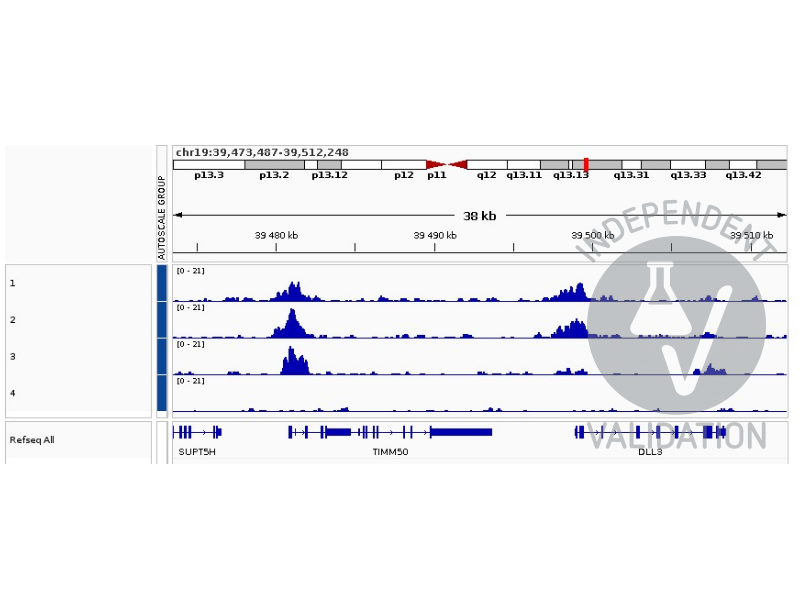
1+2. Two replicated alignment tracks from CUT&RUN targeting ASCL1 in neuroendocrine cancer organoids using anti-ASCL1 antibody ABIN6260073.
3. Positive Control: Alignment tracks from CUT&RUN targeting H3K3me3 in neuroendocrine cancer organoids using anti-H3K4me3 antibody ABIN6971977.
4. Negative Control: Alignment tracks from CUT&RUN targeting and unspecific IgG.
Full Methods -
-
状态
- Liquid
-
浓度
- 1 mg/mL
-
缓冲液
- Rabbit IgG in phosphate buffered saline , pH 7.4, 150 mM NaCl, 0.02 % sodium azide and 50 % glycerol.
-
储存液
- Sodium azide
-
注意事项
- This product contains Sodium azide: a POISONOUS AND HAZARDOUS SUBSTANCE which should be handled by trained staff only.
-
储存条件
- -20 °C
-
储存方法
- Store at -20 °C. Stable for 12 months from date of receipt.
-
有效期
- 12 months
-
-
- ASCL1 (Achaete-Scute Complex Homolog 1 (Drosophila) (ASCL1))
-
别名
- ASCL1
-
背景
-
Description: Transcription factor that plays a key role in neuronal differentiation: acts as a pioneer transcription factor, accessing closed chromatin to allow other factors to bind and activate neural pathways. Directly binds the E box motif (5'-CANNTG-3') on promoters and promotes transcription of neuronal genes. The combination of three transcription factors, ASCL1, POU3F2/BRN2 and MYT1L, is sufficient to reprogram fibroblasts and other somatic cells into induced neuronal (iN) cells in vitro. Plays a role at early stages of development of specific neural lineages in most regions of the CNS, and of several lineages in the PNS. Essential for the generation of olfactory and autonomic neurons. Acts synergistically with FOXN4 to specify the identity of V2b neurons rather than V2a from bipotential p2 progenitors during spinal cord neurogenesis, probably through DLL4-NOTCH signaling activation.
Gene: ASCL1
-
分子量
- 25 kDa
-
基因ID
- 429
-
UniProt
- P50553
-
途径
- Dopaminergic Neurogenesis
抗原
-