
RNA Based Therapeutics
Over the past decades RNA based therapeutics gained importance. Especially in diseases with genetic causes, oligonucleotide chains offer a promising therapy approach - often the first ever. Currently there are two main approaches used to target RNA: double stranded RNA-mediated interference (RNAi) and antisense oligonucleotides (ASO). Both approaches are currently in clinical trials for targeting of RNAs involved in various diseases, such as cancer and neurodegenerative diseases. antibodies-online can support you in the development of RNA based therapeutics.
Challenges in Therapeutic Production
Due to its sequence specificity, an oligo therapeutic can in principle be used against any mRNA and thus against any disease treatable by gene knockdown. However, the use of oligos also comes with potential obstacles, such as the comparatively rapid degradation of RNA in the bloodstream and the targeted uptake of the therapeutic — preferably in diseased cells or tissues of an organism.
The evolution of the medicinal chemistry of oligonucleotides has been critical to the steadily improving performance of ASOs in the clinic. ASOs are oligomeric and comprised of nucleotide analogs. Because ASOs can be designed to work through a variety of post-RNA-binding mechanisms, numerous designs have been evaluated. As new molecular mechanisms of action are identified and new insights into the molecular mechanisms of distribution, cellular uptake and subcellular distributions, and various toxicities are reported, the designs are becoming progressively more complex.
Oligonucleotide Medicinal Chemistry: Modifications and their Advantages
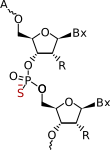
The phosphorothioate (PS) modification is broadly used in all major classes of ASOs and all chemically modified siRNAs. The replacement of one nonbridging oxygen with a sulfur alters the physicochemical characteristics of the phosphate in important ways. Because the sulfur atom is twice as large as the oxygen atom, the charge distribution, bond angles, and stretching of PS links differ substantially from phosphodiester (PO) linkages. The sulfur substitution spreads the charge and makes the phosphate more “lipophilic,” thereby facilitating binding to proteins. Generally, for proteins that require PS moieties to bind ASOs, the minimum number of this modification needed to support meaningful protein interactions is 10. The enhanced protein binding enabled by PS substitutions is critical as protein binding of ss PS ASOs plays crucial roles in the absorption, distribution, cellular uptake, intracellular distribution, activity, and toxicity of PS ASOs.
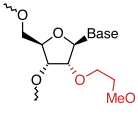
Modifications at the 2′ position of the ribose ring are commonly used to help increase oligonucleotide stability and improve resistance to nuclease activity in vivo. RNA oligonucleotides synthesized using 2′-MOE modifications, known as phosphoramidites, have shown to be more nuclease resistant, with lower toxicity, and slightly increased hybridization affinities, making them well suited for therapeutic in vivo applications, such as ASO, siRNA, and aptamers. 2'-O-methylnucleotides offer advantages due to their kinetic and melting properties. 2'-O-Methyl oligoribonucleotide probes bind to RNA targets faster and with much higher melting temperatures (Tm) at various probe length. Because of their greatly enhanced Tm when bound to RNA, 2'-O-methyl oligoribonucleotide probes can efficiently bind to double-stranded regions of structured RNA molecules. The increased Tm, faster kinetics of hybridization, ability to bind to structured targets and increased specificity of 2'-O-methyl oligoribonucleotide probes render them superior to corresponding 2'-deoxy oligoribonucleotides for use in assays that detect RNA targets.
PS: Phosphorothioate
2’-OMe: 2'-O-methylated Nucleosides
2’-MOE: 2-Methoxyethyl
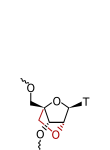
2’-LNA: Locked Nucleic Acid
2′-MOE-modified oligonucleotides have demonstrated that the oligonucleotides exhibit a tissue distribution similar to phosphorothioate oligodeoxynucleotides (PS ODNs) and decreases toxicities compared to PS ODNs. Additionally, 2ʹ-MOE substitution significantly reduces proinflammatory effects.
Therapeutic viability of siRNA gene silencing is dependent on improvements in molecule bio-stability, specificity and delivery, which can be overcome by modifying of siRNA with Locked Nucleic Acid (LNA), a nucleic acid analogue with unprecedented binding affinity. LNA provides excellent specificity toward complementary RNA and DNA oligonucleotides. Incorporating LNA substantially enhances serum half-life of siRNA's, which is a key requirement for therapeutic use. Moreover LNA is compatible with the intracellular siRNA machinery and can be used to reduce undesired, sequence-related off-target effects. The remarkable properties of LNA have led to applications within various gene silencing strategies both in vitro and in vivo.
Case Study: Antisense Oligonucleotide Silencing of FUS
Fused in sarcoma (FUS) is an RNA-binding protein that is genetically and pathologically associated with rare and aggressive forms of amyotrophic lateral sclerosis (ALS) and frontotemporal dementia (FTD). Korobeynikov et al researched on ION363, a non-allele-specific FUS antisense oligonucleotide. ION363 efficiently silences FUS and reduces postnatal levels of FUS protein in the brain and spinal cord, delaying motor neuron degeneration. In mouse genetic and human clinical studies, evidence is provided in support of FUS silencing as a therapeutic strategy in FUS-dependent ALS and FTD.
The Detection Challenge
Developing and manufacturing oligonucleotide therapeutics requires rigorous, consistent analytical methods at every stage. Traditionally, ISH-type assays have been the primary method of detecting and localizing oligonucleotides in cells and tissues. However, ISH cannot bind and detect short oligonucleotide therapeutic sequences, and requires unique probes for each individual candidate — making probe development and candidate triage time-consuming and expensive.
Many conventional analytical methods are further limited by sequence dependence, complex probe design, or reduced sensitivity for chemically modified oligonucleotides, creating an unmet need for robust alternatives.
Reliable Detection of Modified Oligos: ModDetect® Panels
Rockland's ModDetect® panels are ready-to-use, immunoassay-based alternatives that provide robust detection and localization of oligonucleotide therapeutic drug delivery, facilitating the collection of ADME analytical data for regulatory approval. The universal nature and unique specificity and sensitivity of these reagents eliminates the need for unique probes and accelerates candidate triage — a cost-effective, low-risk solution that can save 9–12 months in drug development.
ModDetect® panels comprise monoclonal antibody reagents directed against nucleic acid backbones or sugar modifications in a sequence-independent manner, with each panel designed for a specific chemical modification. These antibodies provide sensitive and versatile tools for visualization, quantification, and detection across established immunoassays including ELISA, immunocytochemistry (ICC), and immunohistochemistry (IHC). Available as unconjugated and biotinylated formats, ModDetect panels are distributed internationally through antibodies-online, offering researchers outside the US a straightforward route to access these reagents.
Related Products and Resources
References
- : "Control of phosphorothioate stereochemistry substantially increases the efficacy of antisense oligonucleotides." in: Nature biotechnology, Vol. 35, Issue 9, pp. 845-851, (2017) (PubMed).
- : "Cellular uptake and trafficking of antisense oligonucleotides." in: Nature biotechnology, Vol. 35, Issue 3, pp. 230-237, (2017) (PubMed).
- : "Short antisense oligonucleotides alleviate the pleiotropic toxicity of RNA harboring expanded CGG repeats." in: Nature communications, Vol. 12, Issue 1, pp. 1265, (2021) (PubMed).
- : "Antisense technology: A review." in: The Journal of biological chemistry, Vol. 296, pp. 100416, (2021) (PubMed).
- : "Antisense technology: an overview and prospectus." in: Nature reviews. Drug discovery, Vol. 20, Issue 6, pp. 427-453, (2021) (PubMed).
- : "Advantages of 2'-O-methyl oligoribonucleotide probes for detecting RNA targets." in: Nucleic acids research, Vol. 26, Issue 9, pp. 2224-9, (1998) (PubMed).
- : "Locked nucleic acid (LNA) mediated improvements in siRNA stability and functionality." in: Nucleic acids research, Vol. 33, Issue 1, pp. 439-47, (2005) (PubMed).
- : "RNA therapeutics: RNAi and antisense mechanisms and clinical applications." in: Postdoc journal : a journal of postdoctoral research and postdoctoral affairs, Vol. 4, Issue 7, pp. 35-50, (2016) (PubMed).
- : "Antisense oligonucleotide silencing of FUS expression as a therapeutic approach in amyotrophic lateral sclerosis." in: Nature medicine, Vol. 28, Issue 1, pp. 104-116, (2022) (PubMed).
- : "Antibody-Oligonucleotide Conjugates as Therapeutic, Imaging, and Detection Agents." in: Bioconjugate chemistry, Vol. 30, Issue 10, pp. 2483-2501, (2020) (PubMed).

Creative mind of antibodies-online with a keen eye for details. Proficient in the field of life-science with a passion for plant biotechnology and clinical study design. Responsible for illustrated and written content at antibodies-online as well as supervision of the antibodies-online scholarship program.
前往作者页面


